The Leaf Mould Composting Process
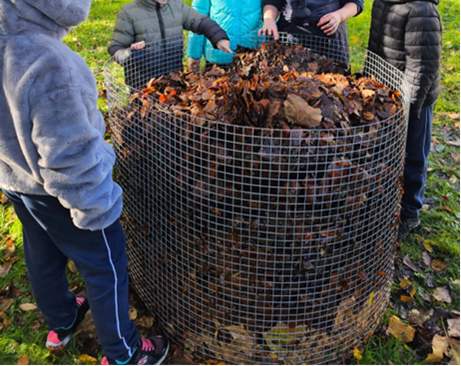
Leaf mould is compost made by allowing autumn leaves to decompose in the presence of air and moisture. This encourages the growth of fungi which along with other organisms (like worms, insects etc.) use the dead leaves as a food source, causing the leaves to slowly turn into a dark and crumbly compost.
The leaf mould process produces a weed-free mulch after 1 year, and compost after 2 years. Using leaf mould in school gardens helps increase organic matter and soil biodiversity. It also helps to improve soil structure, retain moisture in soil, and provides plants with essential nutrients.

BACKGROUND INFORMATION

- SUBJECTS: Science, Geography, Global Citizenship Education, Mathematics, Literacy
- TIME OF YEAR: Autumn or early winter, when leaves are plentiful
- REQUIRED PREMISES: classroom or schoolyard
- PREPARATION REQUIRED: Identify a suitable location for the leaf mould enclosure, ideally in a shady corner of the school garden. Allow room around the enclosure for people to be able to see into the pile.
- TIME REQUIRED:
– Initial setup: approximately 1 hour
– Ongoing maintenance: Minimal (check every few weeks)
– Final use of leaf mould: After 6-12 months as a mulch, and after 18-24 months as a composttem
REQUIRED MATERIALS

- Quantity of wire or plastic mesh, pallets, wooden stakes, or any material suitable for making an enclosure to prevent the leaves from blowing away.
- A good size is around 1 metre wide and 1 metre high.
- Garden rake or leaf blower (optional)
- Gardening gloves should be worn for safety
- Large bags, buckets, and/or wheelbarrows may be needed for transporting leaves
- Watering can or hose a nd access to water to keep the leaves moist
- Labels or signs for the leaf mould bin
- Measuring stick or ruler (to track the height of the leaf pile over time)
The Leaf Mould Composting Process – Step by Step
- Step 1: Build the Leaf Mould Bin
- Construct a simple but sturdy enclosure to hold the leaves in place. Wire or plastic mesh may need to be supported using stakes.
- Ensure the bin is open at the top and has space around it for air to circulate.
- Step 2: Collect and Add Leaves
- Gather leaves from suitable locations in the school grounds or nearby.
- Place the leaves into the holding area, packing them loosely to allow air to circulate.
- If leaves are dry, sprinkle them with water to help with decomposition.
- Step 3: Monitor the Leaf Mould
- Measure the height of the leaf pile and continue to take measurements over time.
- Observe changes and look for signs of fungi and small animals. Riffle through the top of the pile to see if any little creatures are living there. Do this gently and slowly, trying not to disturb any habitats too much.
- Check the bin every few weeks to ensure the leaves remain moist. If the pile seems very compacted, you might need to dig through it with a garden fork to ensure that it all has available air and water.
- If the pile shrinks too much, add more leaves as needed. This will help to keep the pile moist.
- Step 4: Use the Leaf Mould
- After 6-12 months, the leaves will have partially broken down, and after 18-24 months they should be almost completely composted, with very little of the original materials visible any more
- Use the leaf mould in the school garden to improve soil health and retain moisture where needed.
- Variations on the process
- If leaves are shredded for example with a lawnmower, they will compost much quicker.
- Mixing in coffee grounds or green leafy plant material from grass, nettles, comfrey, or seaweed will also speed up the composting process, as well as greatly increasing the amount of nitrogen and other nutrients in the finished compost.
- A pile of pine needles will turn into a more acidic leaf mould, suitable for acid-loving plants.
- Tree seeds can be germinated and grown into young trees in leaf mould. In fact, they love it – a bed of damp rotting leaves in a moist, sheltered, and shady location will give them an environment not too different from life on the forest floor.
HINT

Leaf mould can hold up to 500% of its weight in water, making it an excellent soil conditioner for dry areas.