7 Steps Towards a Green School
This step-by-step guide provides you with information on the most important aspects of putting together your team, planning, implementation and operation of your greening project on, around and in your school or educational institution.
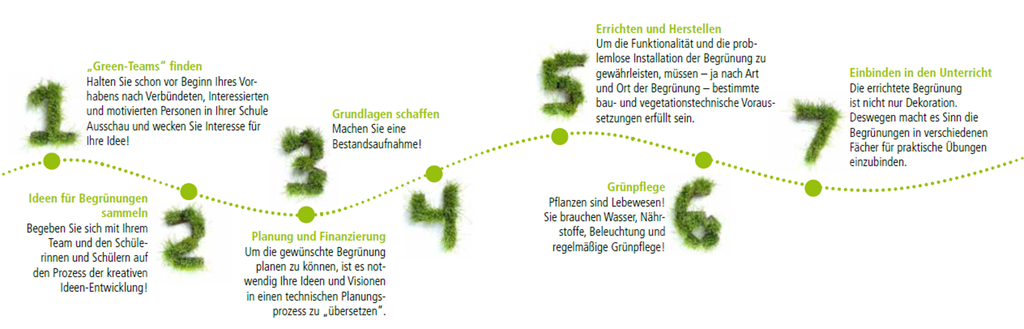
This guide can not only serve as orientation and support while brainstorming or discussing greening measures in the school building, but also be used as a checklist to assist with planning and implementation.

Step 1: Find Green Teams
Even before you start your project, look out for allies, interested people and motivated colleagues at your school and spark their interest in your idea!
The more people are actively involved and fully committed to the idea, the better the planning, implementation and maintenance of the greening will succeed.
Ideally, you will find supporters with an interest in greenery who would like to take care of the greening measures together:
Who should be part of the team?
- Teachers who teach in the respective greened room (including class teachers)
- Teachers who teach related subjects such as biology and environmental studies or geography
- Other interested teachers, staff from afternoon care and people from the wider school community
- Students
- Janitors/caretakers
- Cleaning staff
As part of the external process support, a kick-off meeting is held to present the process, reach out to further interested persons, clarify roles and define a timeframe.
Step 2: Collect ideas for greening
Embark on a creative idea-development process together with your team and the students!
The process of developing ideas can take place during lessons, in staff meetings or quite informally in everyday conversations and exchanges. The school management can make a significant contribution to building a core team by helping to provide resources for those involved, especially at the beginning of the process. This step can include:
- Bringing your ideas to staff meetings and discussing them with your colleagues.
- Seeking the support of the principal. They carry the responsibility and, through their commitment and motivation, can help ensure the sustainable implementation of the greening project.
- Enabling teachers, during the preparation phase and at the beginning of the greening process, to attend core team meetings by releasing them from some duties, and considering innovative models of time compensation for the summer months.
- Being aware that without the support of the school management, it is difficult for teachers to drive the formation of a core team and to find time for coordination.
As part of the external process support, workshops and idea labs are designed and moderated to collect ideas for greening. Showcasing good practice examples provides inspiration and encourages thinking beyond the obvious.


Step 3: Lay the groundwork eams
Start by taking stock of the current situation!
Once the core team is in place, align your greening ideas for indoor and/or outdoor spaces with the actual structural, spatial and technical conditions of your school.
Clarifying requirements
- Check whether the necessary conditions for implementing your idea(s) are in place, such as fire protection measures and water supply, whether structural changes are needed, and whether you require official approval for your project.
- Consider the location and type of greening: technical system or self-built solution? The choice of greening system is directly linked to both installation costs and ongoing operating costs.
Obtaining approvals
- The type and scope of the planned project determine which approvals are required. Since indoor greening usually involves minor construction work within the building, a general building permit is often not necessary.
- For greening measures that are permanently installed in or on the building, you must contact the building owner and coordinate regarding the construction of the green wall.
As part of the external process support, we support you with a checklist for taking stock of the current situation, reflect on which requirements need to be met to implement your idea(s) and which structural adaptations are possible. We assist you in obtaining the necessary basic information from the school authority or building owner and in dealing with any approval procedures required by public authorities for your school greening project.
Step 4: Planning and financing
To be able to plan the desired greening measures, it is necessary to translate your ideas and visions into a technical planning process.
Consulting specialists
- If you decide to install a technical system, it is essential to contact experts and seek advice on an appropriate and standard-compliant design.
- If you intend to use so-called self-build systems, it is advisable to consult specialists to review your initial drafts and plans.
- Also think ahead to ongoing operation, plant care and maintenance. Take school holidays into account, as well as the need to continuously recruit new participants in order to ensure the continuity of the working group.
To help inspire your project, here are some building instructions.
Costs and financing
Financing is a key part of the planning process and relates not only to the installation of your school greening project but also to its ongoing operation, including care and maintenance. Only when both aspects have been considered and secured will you be able to benefit from your greening in the long term.
- Based on your initial concepts and plans, estimate the costs to be expected and, if necessary, contact manufacturers to ask for specific prices.
- Look for funding opportunities, for example through the school authority, support from the parents’ association, donations and sponsorship, or by submitting smaller project applications.
As part of the external process support, we support you in translating your ideas into a plan and connect you with experts who have specialist greening know-how. We assist you in identifying suitable funding opportunities and provide support with funding applications.

Step 5: Construction and installation
In order to ensure proper functioning and smooth installation of the greening, certain construction-related and vegetation-related requirements must be met, depending on the type and location of the greening. When technical systems are installed in new or existing buildings, the construction work must be carried out by (certified) specialist companies.
- Construction-related requirements ensuring the proper functioning and installation of the greening include, among other things, fire safety requirements, load-bearing capacity of the façade, and the availability of all necessary connections.
- For technical greening systems, construction work must be carried out by specialist companies in coordination with the building owner or school authority. For systems with a water supply and drainage, the necessary pipes must be rerouted by certified companies. In new buildings it is important to take existing warranties of the companies involved into account when any conversion work is carried out.
- The construction and installation of DIY greening solutions can be supported by experts who are experienced in implementing greening projects together with non-professionals and students.
As part of the external process support, we support you during implementation and help you find the right expert to realise your greening project together with you. By involving the greening team in the installation and providing additional knowledge transfer, the project becomes a valuable, holistic learning experience and strengthens everyone’s identification with the initiative.
Step 6: Green maintenance lanning and financing
Plants are living beings! They need water, nutrients, light and regular care.
The care and maintenance of green walls can work particularly well when different people collaborate and a core team is established.
Regular inspection
- It is important to regularly check the plants in order to assess their vitality and condition, identify problems early and respond quickly with appropriate measures. At a glance, you should make sure that the power supply for irrigation and lighting is working properly and get an overall impression of the state of the plants.
- These inspections can be carried out by anyone who has been trained for this purpose. They must also be ensured during school holidays.
- Over time, you develop a feel for the greening and can tell with a quick look whether the plants are thriving and whether irrigation times, lighting periods or the amount of nutrients need to be adjusted.
As part of the external process support, we organize suitable, recurring training formats for everyone involved in the process.


Step 7: Integrate it into teaching
Make greening a visible part of school culture! The installed greening is not just decoration. It therefore makes sense to integrate it into different subjects as a basis for practical, hands-on exercises.
Green walls and surfaces are ideal for use in the curriculum as tangible project topics, practical exercises and in a variety of teaching formats. In addition to linking them to subject content in lessons, it also makes sense to integrate their care and maintenance into the curriculum. For example, responsibility for the green walls can be assigned to a class within different subjects such as biology or craft/woodwork. Following a peer-to-peer approach, further responsible students can be involved over time, helping to foster their soft skills.
“Green” external impact
The positive external impact of school greening, for example at school events, on open days or on the school website, strengthens the school’s profile. In practice, students and teachers are often proud to present these green spaces and speak vividly about their experiences.
Also involve the wider school community: integrating the green walls as a permanent feature in school activities and events is a real asset. It helps to clearly highlight the school’s unique selling proposition (USP). The greened spaces can be used as venues for celebrations, or students can offer guided tours for visitors and share their experiences with the green walls.