Details for review and rating for this initiative at the bottom of this page
The Project
Green Learning Corridor Ergani is a planned student-led greening and outdoor learning initiative at Ergani Kız Anadolu İmam Hatip Lisesi in Diyarbakır, Türkiye.
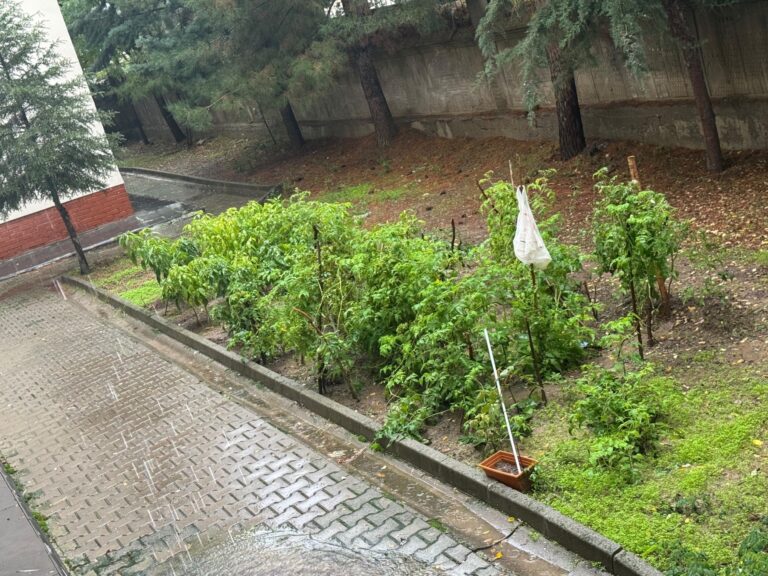
The project will build on the school’s existing green areas rather than creating an entirely new garden. The school already has mature trees, shaded areas, narrow planting strips and a small area used for limited seasonal cultivation. The initiative aims to improve and connect these existing spaces so that they function as one coherent biodiversity and outdoor learning environment.
The main physical focus will be the improvement of the existing planting strips with locally appropriate, drought-tolerant and low-maintenance flowering plants. Particular attention will be given to pollinator-friendly species and plants that are suitable for the hot and dry summer conditions of the region.
A small existing cultivation area will be maintained as a supporting element of the project and may continue to be used for simple seasonal planting activities such as herbs or vegetables where feasible.
The mature trees and shaded parts of the school grounds will be used as an outdoor observation and learning area. These spaces will support short activities related to biodiversity, climate change, plant life, ecosystems, sustainability and responsible use of natural resources.
Simple student-made plant labels, environmental signs and basic biodiversity features may be introduced gradually according to available resources. These elements will help connect the different parts of the school grounds into a small green learning route.
A student-teacher Green Team will be established as part of the initiative. The team will contribute to planning, maintenance, monitoring and documentation of the project.
The initiative will follow a simple cycle of assessment, planning, implementation, documentation, monitoring and improvement. Before implementation, students and teachers will record the existing condition of the selected areas through photographs and a simple site assessment. As the project develops, progress will be documented and reviewed so that future improvements can be based on experience.
The long-term aim is to create a manageable, visible and educational green space that can be maintained and gradually improved without requiring major construction or extensive financial resources.
The main motivation for the initiative is to make better educational and environmental use of green areas that already exist within the school grounds.
The school has mature trees, planted areas and small cultivated sections, but these spaces currently function largely as separate elements. The initiative aims to connect and improve them so that they have greater ecological and educational value.
Another motivation is to make environmental education more practical. Topics such as biodiversity, climate change, sustainability and responsible use of natural resources are often discussed in classrooms. The project will provide students with a real environment in which they can observe, participate and take responsibility.
The initiative is also intended to strengthen student participation. Students will be involved not only in maintenance, but also in observing the existing area, suggesting improvements, monitoring changes and contributing to future development.
The project is deliberately designed to be realistic and manageable. Rather than requiring major construction, it will improve the existing environment gradually and according to available resources.
Participation in the Green Cool Schools Network will also allow the school to present its initiative internationally and become part of a wider community of schools working on sustainability and greener learning environments.
The initiative will combine practical greening activities, student participation, environmental education and simple monitoring.
At the beginning of the project, students and teachers will carry out a basic assessment of the selected school areas. This will include observing existing vegetation, shade, soil conditions, current use of the space and possible areas for improvement.
A small student-teacher Green Team will then be formed to support planning and coordination.
Practical activities may include preparing existing planting areas, introducing suitable flowering plants, maintaining the existing seasonal cultivation area, watering, removing weeds, checking plant health and replacing plants where necessary.
During suitable seasons, students will participate in planting and maintenance activities. Regular care will take place according to seasonal needs rather than through a rigid fixed schedule.
The green areas will also be used for educational activities related to biodiversity, climate change, ecosystems, sustainability and the Sustainable Development Goals. These activities may be integrated into English, science, geography or interdisciplinary school work.
Students may document plant growth, flowering periods, seasonal changes and the presence of pollinating insects through photographs, observation notes or short classroom activities.
Simple awareness activities, student presentations, posters or school displays may also be organised during the school year.
Where appropriate, the school may seek advice or in-kind support from local nurseries, municipal services, universities or other local organisations.
More details
The initiative is designed as a low-cost and gradually implemented school project.
Existing school green areas and infrastructure will form the basis of the project, reducing the need for major construction or landscaping costs.
Initial needs are expected to include basic planting materials, suitable plants, soil improvement where necessary, simple signs or labels, and basic maintenance materials.
Implementation will be planned according to the local climate. Major planting activities will preferably take place during the cooler and wetter parts of the year so that plants can establish before the hot and dry summer period.
Available school resources, reused materials and modest voluntary contributions may support the initial phase. The school may also seek in-kind support from local nurseries, municipal services or other local organisations for plants, soil, materials or technical advice.
The project is intended to remain flexible and can be adapted or expanded according to available resources. No external grant funding has currently been secured.
As the initiative is currently at the idea stage, the results described below are expected rather than already achieved.
The project is expected to:
– improve the ecological and educational value of existing green areas within the school grounds;
– create a more coherent green learning corridor connecting planted and shaded areas;
– introduce additional drought-tolerant and pollinator-friendly vegetation;
– maintain and make educational use of the small existing seasonal cultivation area;
– establish a student-teacher Green Team;
– increase student participation in practical environmental activities;
– create opportunities for outdoor and interdisciplinary learning;
– improve student awareness of biodiversity, climate change and sustainability;
– produce simple documentation of the development of the project through photographs, observations and student work;
– establish a realistic model that can be maintained and gradually improved in future school years.
As the initiative is currently in the planning stage, it has not yet produced measurable impact or formal achievements.
The expected impact is to give students a more active role in the school environment and to improve how the existing green areas are used.
A core group of students and teachers will participate directly in planning, planting, maintenance and monitoring, while a wider number of students may benefit through lessons, awareness activities and use of the outdoor areas.
The initiative is expected to improve student awareness of biodiversity, climate change and sustainable development and encourage greater responsibility for shared school spaces.
It is also expected to create a visible environmental initiative within the school that can be documented and presented to the wider school community.
Progress will be followed through photographs, student observations, participation records and simple periodic reviews.
As the initiative is still at the idea stage, student participation will be built into the project from the beginning.
Students will be invited to contribute ideas about how the selected areas can be improved, what types of environmental activities they would find useful and how the space could be used for learning.
A small student-teacher Green Team will be formed to represent student ideas during planning and implementation.
Students will participate directly in activities such as observing the site, planting, watering, basic maintenance, monitoring seasonal changes and documenting the development of the project.
Student feedback will also be considered when deciding how the initiative should be adapted or expanded in future stages.
- Students
- Teachers
One of the first future steps will be the establishment of a student-teacher Green Team.
The Green Team will help coordinate activities, collect student ideas, monitor the condition of the green areas and support documentation of the project.
The school plans to begin by identifying the exact areas to be improved and recording their current condition through photographs and a simple site assessment.
The main planting areas will then be improved gradually with suitable drought-tolerant and pollinator-friendly plants according to available resources and seasonal conditions.
The shaded areas beneath existing mature trees will increasingly be used for outdoor observation and environmental learning activities.
The school also plans to maintain the small existing seasonal cultivation area and use it for simple practical learning activities where appropriate.
Progress will be reviewed periodically. Plants, activities or project elements that are not successful may be adapted, replaced or improved in later stages.
The long-term intention is to maintain the initiative on a manageable scale and gradually improve it according to student interest, available resources and experience gained during implementation.
The School
- Early childhood education
- Primary education
- Lower secondary education
- Upper secondary education
If you do not see the stars or if “Select a rating” is not working, please adjust your privacy settings. Scroll to the bottom of the page, click on “Change my settings”, and select “Accept all”.