Details for review and rating for this initiative at the bottom of this page
The Project
Details of the Green Initiative
The project BEYOND the WALLS places the lives of people in today’s global society at the centre of its artistic and educational approach. Textile recycling, sustainability, and the consequences of overproduction form the core thematic framework. By combining cultural education with environmental and social education, the project addresses urgent global challenges through a youth-led, performance-based format. Education for Sustainable Development (ESD) is a central pillar of the initiative. The project fosters critical thinking, empathy, and awareness of sustainable consumption, empowering young people to reflect on their own behaviours and responsibilities within global production and consumption systems. BEYOND the WALLS aligns closely with the United Nations Sustainable Development Goals, particularly SDG 4 (Quality Education) and SDG 12 (Responsible Consumption and Production).
At the heart of the project is a performance-driven theatrical work that exposes global injustices within the textile industry, with a strong focus on child labour and the denial of access to education. Through a series of documentary-inspired scenes, the performance traces the lived realities of young people whose futures are constrained by exploitative labour systems. Education is presented as a fundamental human right and as a powerful pathway toward social and environmental change.
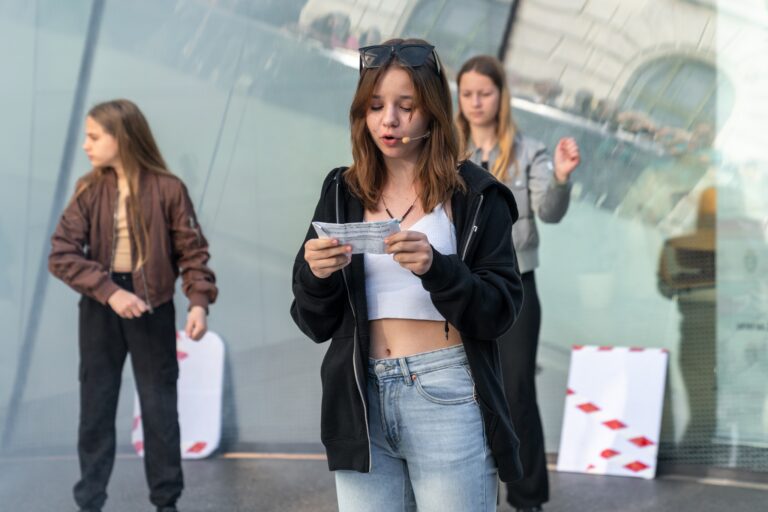
Youth Participation and Creative Process: Young participants of the Drama & Dance Ensemble act as co-creators throughout the entire process. They research issues related to textile production, child labour, sustainability, and ethical consumption, develop original texts based on their findings, record audio material in cooperation with Radio Helsinki – Free Radio Graz, which is integrated into the performance as voice-overs.
This participatory approach strengthens ownership, media literacy, and critical engagement with complex global issues.
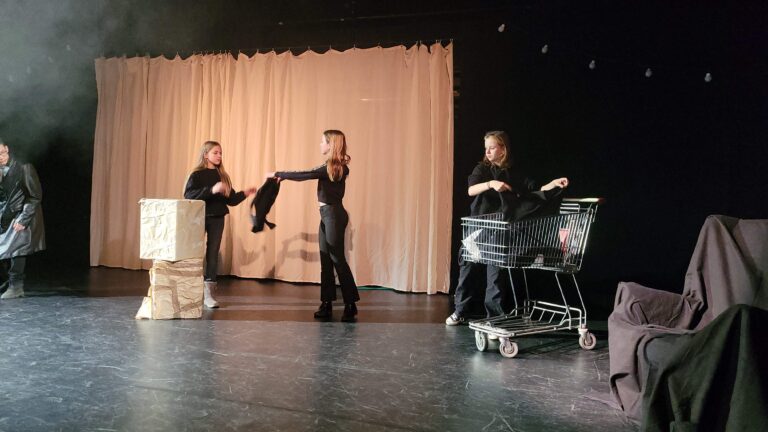
Staging and Environmental Message: The performance is set in a symbolic factory hall, depicting young people working under exploitative conditions. The staging visually and emotionally highlights the connections between:
Overproduction and environmental degradation
Social injustice and power imbalances
Limited access to education
The character of the Big Boss embodies global power structures and responsibility gaps within international supply chains.
Performance Venue: Opera House Graz
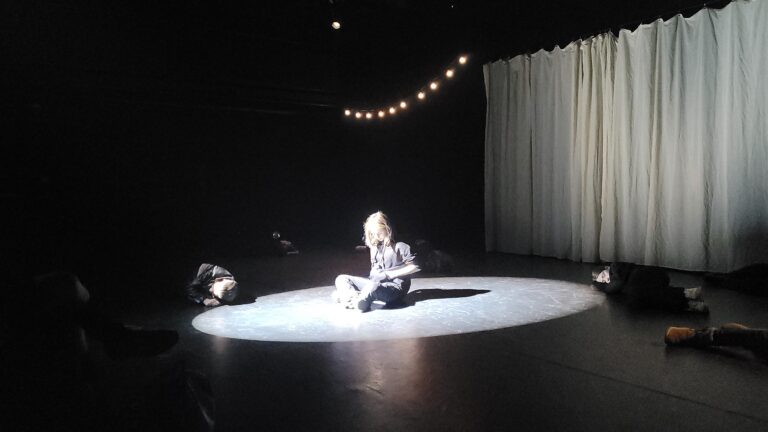
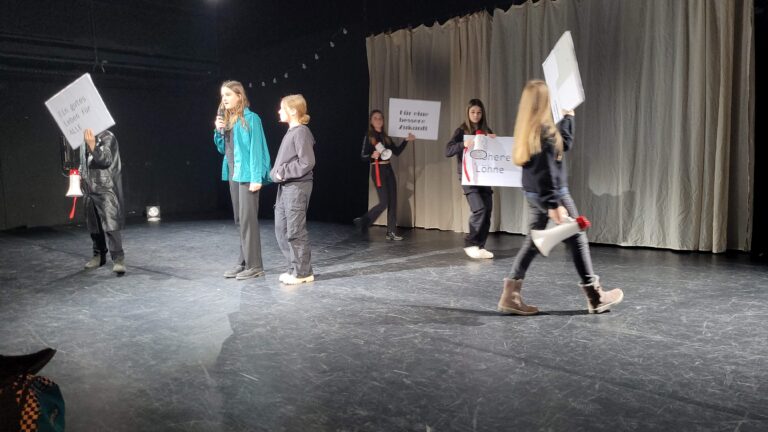
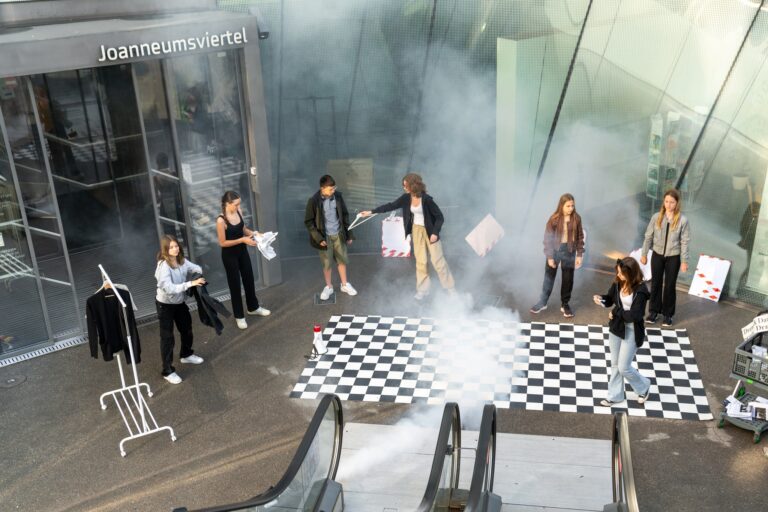
Staging BEYOND the WALLS at the Opera House Graz transforms a traditional cultural venue into a space for youth-led reflection, sustainability advocacy, and social dialogue. The stage design represents multiple environments—including factory halls, corporate offices, and public spaces of social messaging—using lighting, fog, and soundscapes to evoke industrial oppression while contrasting it with moments of hope and resistance.
Multimedia and Media Literacy Integration
The production integrates:
Voice-over recordings
Visual projections and soundscapes
These multimedia elements enhance storytelling and reinforce media literacy, enabling students to communicate complex environmental and social issues effectively. The immersive experience invites audiences to critically reflect on their own roles within global consumption systems.
Impact and Public Engagement: By presenting the performance in a culturally significant and professional setting, the project elevates student voices and transforms the work into a public act of advocacy. The Opera House Graz becomes a forum for dialogue on education, ethical production, and sustainability—bridging art, responsibility, and environmental awareness.
Beyond the Walls addresses critical environmental challenges linked to the global textile industry, emphasizing the connections between production, consumption, and sustainability. The project raises awareness of environmental responsibility through research, artistic expression, and participatory learning.
Key Environmental Focus Areas: Overproduction and Waste: Students explore the ecological consequences of fast fashion and mass textile production, including excessive resource use, pollution, and landfill waste. The performance highlights how overproduction contributes to unsustainable consumption patterns, environmental degradation, and the depletion of natural resources.
Pollution and Toxicity: Through research and performance, participants examine the environmental impact of textile manufacturing, such as water pollution from dyeing processes, chemical use, and emissions. The project encourages reflection on the hidden environmental costs behind everyday clothing.
Resource Use and Carbon Footprint
Students investigate the energy, water, and material inputs required for textile production, highlighting the carbon footprint associated with global supply chains. By translating these findings into theatre and multimedia elements, they illustrate the direct link between consumer habits and environmental outcomes.
Recycling and Sustainable Consumption
The project promotes textile recycling, upcycling, and mindful consumption as actionable strategies for reducing environmental harm. Students creatively incorporate these themes into the performance, demonstrating the importance of responsible choices in everyday life.
Environmental Awareness and Action
Beyond knowledge acquisition, students develop a sense of responsibility for environmental sustainability. The performance encourages audiences to critically evaluate their own consumption patterns and consider ways to support ethical, environmentally conscious production and lifestyle practices.
Educational and Artistic Integration
By combining research, drama, movement, and multimedia, Beyond the Walls transforms abstract environmental concepts into experiential learning. Students engage intellectually and emotionally with global sustainability issues, linking their creative work with real-world environmental challenges. This approach fosters critical thinking, empathy, and action-oriented awareness, empowering youth to become advocates for sustainable change.
By initiating Beyond the Walls, MS & ORG Laßnitzhöhe embodies its mission as a UNESCO, ÖKOLOG, Fairtrade School, and School of Well-Being, demonstrating that education can function as a genuinely transformative force. The project integrates critical thinking, creativity, ethical awareness, and sustainability, enabling students to explore complex global challenges such as child labour, social injustice, environmental responsibility, and ethical consumption. In doing so, it reflects the school’s commitment to holistic, values-based education that prepares young people for the social, ethical, and environmental demands of the 21st century.
Beyond the Walls is an educational and artistic initiative designed to empower young people to critically reflect on their behaviours, values, and social responsibilities through Drama in Education and participatory theatre practices. Grounded in the pedagogical understanding that embodied and experiential learning fosters deeper comprehension, empathy, and critical awareness, the project addresses interconnected social, environmental, and ethical issues in ways that are both intellectually rigorous and personally meaningful.
A central motivation of the project is the use of drama-based methodologies as tools for reflection, dialogue, and transformation. Through role-play, improvisation, and collective storytelling, students explore diverse perspectives, examine the consequences of individual and collective actions, and experiment with ideas, identities, and social roles beyond the limitations of conventional classroom learning. By consciously stepping “beyond the walls” of traditional education, participants engage with sustainability, fairness, and social justice in imaginative, embodied, and emotionally engaging ways.
The project also aims to strengthen students’ sense of agency and civic responsibility. Collaborative theatrical processes foster essential competencies such as communication, cooperation, critical thinking, and problem-solving, while helping students recognise their own capacity to contribute to social change. Reflection is consistently linked to action, encouraging participants to transfer insights gained through artistic exploration into responsible decision-making within their communities and everyday lives.
Furthermore, Beyond the Walls reflects the school’s strong commitment to interdisciplinary, student-led learning, combining the arts, social sciences, environmental education, and media literacy. This holistic approach equips students with the knowledge, skills, and values needed to navigate complex global systems and to understand how personal choices are embedded within wider social, cultural, environmental, and economic structures.
Beyond the Walls demonstrates that education at MS & ORG Laßnitzhöhe extends far beyond academic instruction. The project serves as a platform for ethical reflection, social awareness, and sustainable action, supporting the development of empathetic, socially engaged, and responsible young people who are prepared to contribute actively to a fairer, more inclusive, and more sustainable future.
The project focuses on life in today’s consumer-driven society, addressing key issues such as textile recycling, sustainability, overproduction, and social responsibility. Students of the Drama & Dance Ensemble critically examine injustices within the global textile industry and explore the ecological and social consequences of consumer behaviour. Through interdisciplinary, sustainability-focused activities, the project combines research, artistic creation, and media literacy to foster awareness and active engagement.
Interdisciplinary Learning and Collaboration: The initiative integrates drama, dance, research, and media production. Students work collaboratively, strengthening teamwork, communication, and problem-solving skills while engaging with complex environmental and social challenges from multiple perspectives.
Key Activities
Research and Critical Reflection: Students conduct independent research on the global textile industry, focusing on issues such as child labour, overproduction, and environmentally harmful production practices. They analyse the links between consumer behaviour, environmental degradation, and social injustice, developing critical thinking and an understanding of global interdependencies.
Creative Development and Performance: Guided by their drama teacher, students translate their research and reflections into an original theatre performance. They write scripts, develop stage directions, design choreographed movement, and experiment with expressive forms of storytelling. This process makes abstract ecological and social issues tangible and emotionally accessible to audiences.
Media Literacy and Audio Production: In cooperation with Radio Helsinki – Free Radio Graz, students create and record audio content that is integrated into the performance as voice-overs. This activity enhances media literacy, technical skills, and the ability to communicate sustainability-related messages through contemporary media formats.
Reflection on Sustainability and Social Responsibility: Throughout the project, students engage in structured reflection on textile recycling, ethical consumption, and environmental responsibility. They connect personal lifestyle choices with wider social and ecological impacts, encouraging a sense of responsibility and agency in contributing to a fairer and more sustainable future.
More details
Marktgemeinde Laßnitzhöhe
The result is a powerful, youth-led stage performance that combines documentary material, physical theatre, spoken text, movement, and collective voice. Presented in the Opera House, the performance transforms the stage into a space of public dialogue and social engagement, making global injustice visible while empowering young performers to articulate informed demands for change. The work demonstrates how performance can function simultaneously as an educational, political, and ethical act, inviting audiences to reflect on their own responsibility in shaping a fairer and more sustainable future.
The on-stage performance represents the culmination of a participatory, performance-based learning process in which students translate research, dialogue, and collective inquiry into a shared theatrical event. Devised collaboratively, the performance draws on the participants’ lived experiences, critical reflections, and creative responses to themes of social responsibility, fairness, and sustainability. This process-centred approach ensures that the final performance is not merely representational, but grounded in authentic engagement and student ownership.
Artistically, the performance employs non-linear structures, shifting roles, fragmented scenes, and symbolic imagery to explore the tensions between individual choice and collective consequence. The stage becomes more than a site of representation; it functions as a space of critical encounter, where personal narratives intersect with broader social, environmental, and ethical questions. Rather than encouraging passive spectatorship, the performance actively challenges audiences to engage intellectually and emotionally with the issues presented.
By occupying the stage of a major cultural institution, the young performers claim visibility within public and civic discourse. Their presence reinforces the legitimacy of youth perspectives and positions performance as a medium for expression, critique, and dialogue. The project deliberately challenges traditional boundaries between performer and audience, encouraging reflection on shared responsibility and the potential for social change beyond the theatrical moment.
The performance serves both as a significant artistic outcome and a meaningful educational intervention. It embodies the project’s core aims by demonstrating how Drama in Education can foster empowerment, critical awareness, and social engagement, while offering audiences an opportunity to reconsider their own roles within global systems of consumption and responsibility.
The project was awarded the Media Literacy Award, recognising its innovative approach to media education and its high pedagogical quality. The jury particularly highlighted the project’s integration of critical media analysis, research-based inquiry, Drama in Education, and public performance. Through the combination of documentation, interpretation, and creative expression, Beyond the Walls significantly strengthened participants’ media literacy.
Students learned to critically examine media narratives, identify power structures within global supply chains, and articulate informed social positions through the responsible and creative use of media. The award confirms Beyond the Walls as an exemplary model of performance-based learning that successfully connects media literacy, artistic practice, and education for sustainability.
In addition to the Media Literacy Award, Beyond the Walls was honoured as a winner of the Energy Globe Styria Award. This prestigious award recognises outstanding initiatives that promote environmental awareness, sustainability, and responsible use of resources. The jury acknowledged the project’s innovative educational approach, which connects sustainability, social justice, and ethical consumption through participatory theatre and media-based learning.
The Energy Globe Styria Award highlights the project’s success in making complex environmental and social issues accessible and meaningful for young people and the wider public. By addressing themes such as overproduction, global supply chains, and the environmental impact of the textile industry,
Beyond the Walls demonstrates how art and education can effectively inspire sustainable thinking and action.
Student Development and Empowerment: The project had a profound impact on the participating students, placing them at the centre of the creative, research, and performance process. Through active involvement in research, media documentation, script development, and staging, students developed critical thinking, problem-solving, and collaborative skills. They gained practical experience in media literacy, learning to analyse information, question dominant narratives, and communicate complex social and environmental issues responsibly. Performing in the professional context of an opera house also fostered self-confidence, public speaking skills, and a sense of agency, reinforcing their ability to influence social discourse and advocate for change.
Awareness of Global and Social Issues: Students deepened their understanding of global injustices, particularly child labour, exploitative production systems, and the environmental impacts of unsustainable practices. By translating research into embodied performance, they were able to connect abstract concepts with lived experiences, fostering empathy and ethical awareness. This experiential learning encouraged young people to consider their personal and collective responsibilities in shaping a fairer and more sustainable world.
The opera house created a space for public dialogue and reflection, engaging audiences with urgent social and environmental issues. By combining dramatic storytelling, multimedia, and documentary elements, the project enabled audiences to critically reflect on their own consumer habits, ethical choices, and societal responsibilities. Audience members were challenged to consider how education, ethical production, and sustainability intersect in global contexts, promoting broader civic awareness and cultural engagement.
Promotion of Sustainability and Media Literacy: The project strengthened awareness of sustainability both for participants and audiences. Students explored the environmental consequences of textile production and the role of education in addressing social inequalities, integrating these insights into their performance and communication strategies. By using media responsibly and creatively, they enhanced both their analytical skills and their capacity to reach audiences effectively, demonstrating how media literacy and performance can drive informed action and social change.
Recognition and Institutional Impact: The innovative combination of student-led research, performance, and media literacy was recognised with the Media Literacy Award, highlighting the project’s excellence in empowering youth, fostering sustainability awareness, and promoting socially engaged learning. The project has also contributed to broader educational discourse by demonstrating the effectiveness of performance-based approaches in connecting young people with complex global issues.
Long-term and Transformative Impact: Beyond the immediate learning and performance outcomes, Beyond the Walls inspired ongoing reflection and action among students, and audiences. It fostered a sense of responsibility and agency in young participants, equipping them with knowledge and skills to advocate for ethical and sustainable practices in their own lives and communities. The project serves as a model for integrating arts, media literacy, and sustainability into education, showing how experiential learning can contribute to both personal growth and broader social impact.
Students were consistently placed at the centre of both the creative and educational process. From initial research to the final opera house performance, they acted as co-creators, researchers, performers, and communicators.
Research and Investigation: Students explored global issues such as child labour, ethical production, and sustainability. They critically analysed media sources, questioned dominant narratives, and gathered information that formed the factual foundation of the performance.
Creative Development and Performance: Participants collaboratively devised scripts, developed stage directions, and shaped the visual and auditory design of the performance. Rehearsing and performing in a professional opera house environment strengthened confidence, stage presence, and collaborative problem-solving skills.
Media Literacy and Communication: Students learned to critically interpret media representations and communicate complex social and environmental issues to diverse audiences. They produced voice-overs, posters, and messaging that combined factual accuracy with creative expression.
Social and Environmental Awareness: Through creative collaboration, students deepened their understanding of global injustices and sustainability challenges, reflecting on personal responsibility and the power of youth action to effect change.
Students were empowered to make decisions regarding performance content, staging, and messaging, ensuring genuine ownership of the project. Their active involvement exemplifies how participatory, performance-based initiatives cultivate agency, critical thinking, and civic engagement in young people.
The artistic concept, direction, and dramaturgy of Beyond the Walls were led by drama teacher Eva Scheibelhofer-Schroll, whose pedagogical and artistic guidance supported students in translating complex global issues into a compelling and meaningful stage performance.
- Students
- Green Team
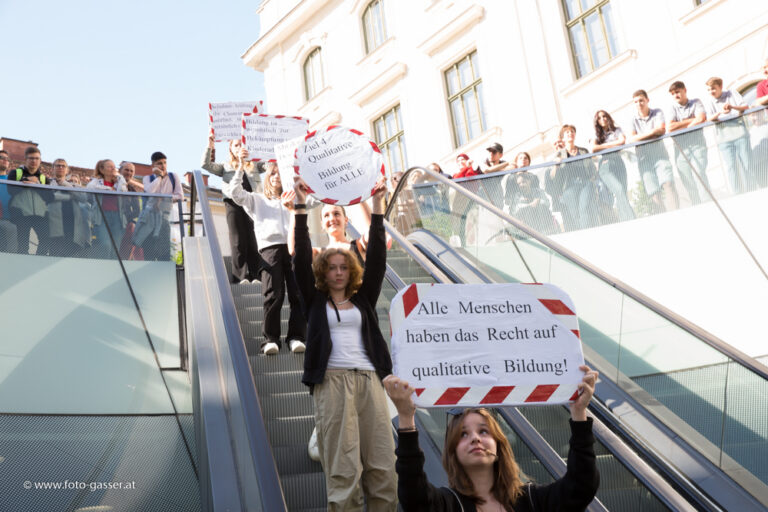
RUNWAY der Menschlichkeit – The TIME is NOW! is a performative art and dance‑theater project created and presented by students. It combines dance, theater and expressive movement to explore themes of empathy, humanity, and global social issues. The presentation takes the form of a Living Gallery of Humanity, where performances and scenes bring concepts and messages to life.
Where It Took Place: The performance was staged at Trichter, a creative space in the Joanneumsviertel arts district in Graz, Austria, featuring around 60 young performers.
What Makes It Special: The concept was developed by the Drama & Dance Ensemble of MS & ORG Laßnitzhöhe under the direction of their teacher.
Art as activism: Rather than a conventional play, the piece uses dance, spoken word, and visual tableaux as a form of “gentle activism” to inspire empathy and convey messages about humanity.
Connection to the SDGs: The performance incorporates the United Nations’ 17 Sustainable Development Goals (SDGs), making them visible and visceral through artistic expression.
The show presents a Living Gallery, where static art forms (like sculptures or tableaux) “come alive” through movement and narrative. Students interpret the SDGs through dance and dramatic scenarios — for example with scenes titled “Be a VOICE!” or “Rainforests in Danger” that evolve into danced and spoken pieces.
The project has been recognized and awarded, including honors such as the FairYoung Styria Prize and success in a Projekt Europa creative competition, highlighting its impact and quality.
The School
- Lower secondary education
- Other
If you do not see the stars or if “Select a rating” is not working, please adjust your privacy settings. Scroll to the bottom of the page, click on “Change my settings”, and select “Accept all”.
27 Reviews on “BEYOND the WALLS”
Congratulations!
Großartiges Projekt!
Ausgezeichnet
Tolle Umsetzung!!
Super Projekt!
Cooles Projekt
Super
Sehr Toll
Großartig!
Sehr gelungen!
Tolles Projekt
Super Projekt
Super Projekt
Spitze💪🏼
Tolles Projekt!!
Sehr cool und wichtig!
Tolles Projekt!
🤩
Großartige Umsetzung!
Amazing idea and project
Schönes Projekt!
👌
Tolle Idee
Tolles Projekt!
Großartiges Projekt
Super Idee.
Super Projekt!!!!