Review and rate this initiative at the bottom of this page
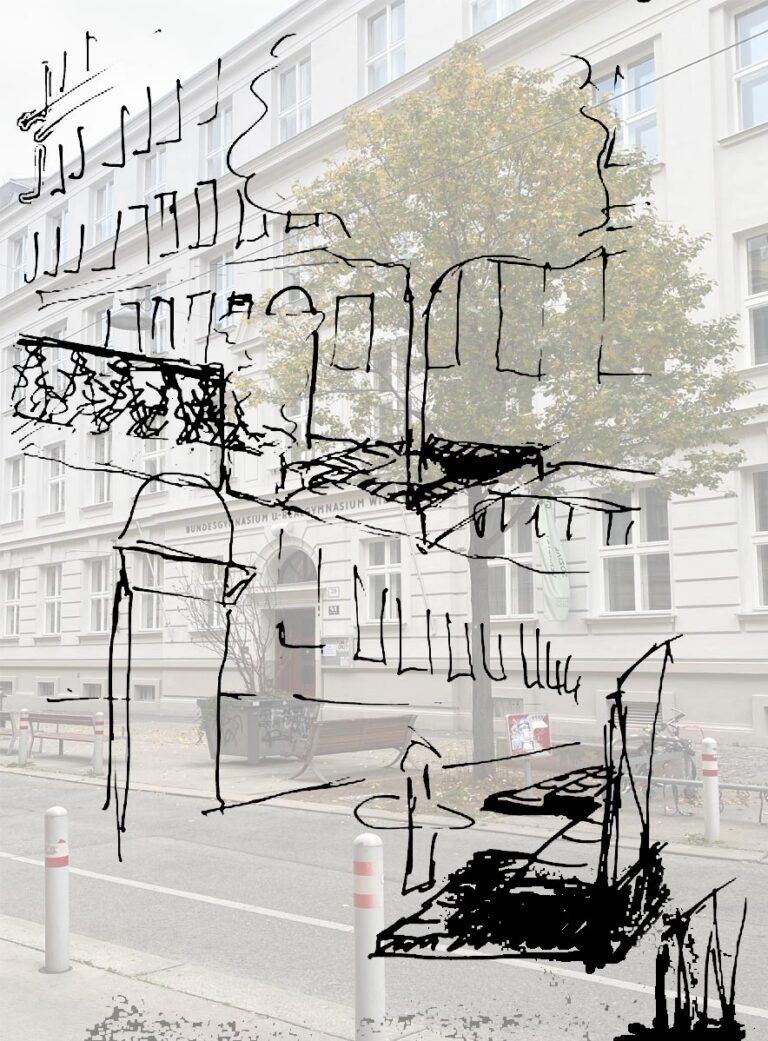
The Project
**Details of the green initiative**
The green initiative is a **school- and community-based urban greening and climate adaptation project** focused on the **school forecourt of the GRG 7 Kandlgasse in Vienna**. It combines **physical greening measures** with **educational and participatory activities** and is designed as a **modular, reversible pilot project** in public space, aligned with the planned future pedestrian zone in the Kandlgasse .
—
1. Type of project
The initiative is a **hybrid project** with three strongly connected dimensions:
1. Physical greening and spatial redesign** of a sealed urban school forecourt
2. Educational and participatory project work** with students, teachers, parents, and local residents
3. Long-term care and stewardship model** for plants and green infrastructure
It is not a one-off planting action, but a **multi-year development process** that starts with temporary and testable measures and can later transition into permanent solutions.
—
2. Greening elements involved
The project explicitly includes **multiple greening elements**, mainly at ground and façade level. Roof greening is *not* part of the current phase.
a) Ground-based greening
Mobile raised beds and large planters**
Built mainly from reusable materials (e.g. pallets, wooden frames)
Can be repositioned or removed if needed
Upgrading existing planting elements**
Refurbishment of existing planters and seating with integrated greenery
Improvement of soil quality and drainage
Tree surroundings (tree pits)**
Partial covering or integration with seating and planting
Coordination with city gardening authorities required
b) Plant types
The planting concept prioritizes **robust, climate-resilient, low-maintenance species**, including:
Perennials and grasses** (heat- and drought-tolerant)
Insect-friendly and pollinator-supporting plants**
Edible plants** (optional), such as herbs or vegetables, where care can be ensured
Climbing plants** for vertical greening elements
The exact plant selection is intentionally left open and developed collaboratively, depending on care capacity and expertise.
c) Façade greening (separate sub-project)
Planned as an **independent, optional project module**
Requires approval from the building owner and authorities
Focus on climbing plants or modular façade systems
Educational focus on microclimate, biodiversity, and building physics
—
3. Activity-based components
In addition to physical greening, the initiative is **strongly activity-based**:
a) Gardening and care activities
Planting during a dedicated **action week**
Ongoing watering, pruning, and maintenance
Care and watering partnerships** (students, parents, local residents)
Summer care schedules to ensure plant survival
b) Educational activities
Integration into regular lessons (e.g. biology, geography, arts, technology)
Project days on:
Climate adaptation and urban heat
Biodiversity and pollinators
Sustainable use of public space
Student-led documentation (photos, texts, presentations)
c) Workshops and participatory formats
Co-design workshops for layout and planting concepts
Small-scale building workshops (e.g. raised beds, seating)
Information events for parents and neighbors
d) Observation and reflection
Monitoring of use, temperature, and acceptance
Reflection on what works and what needs adjustment
Annual evaluation and adaptation of measures
—
4. Character of the initiative
In summary, the green initiative is:
Practical**: real greening in a dense urban environment
Educational**: learning through doing in a real-world context
Participatory**: co-created by school and neighborhood
Climate-oriented**: focused on heat reduction, biodiversity, and water awareness
Reversible and scalable**: suitable as a model for other school forecourts
It combines **visible green infrastructure** (plants, beds, shaded areas) with **long-term engagement**, making the school forecourt both a **learning space** and a **shared green urban space**.
Motivation
The green initiative at the school forecourt of the GRG 7 Kandlgasse is motivated by educational, environmental, social, and urban-planning goals. It responds to concrete local needs while aligning with broader city and school development strategies
2026-01-18 Roadmap Kandlgasse
.
Key motivations include:
Climate adaptation and environmental responsibility
The forecourt is a largely sealed, heat-prone urban space.
Greening measures are intended to reduce heat stress, improve the microclimate, support biodiversity, and promote sustainable water use.
The project makes climate change and adaptation strategies tangible and visible for students.
Educational value and learning by doing
The initiative creates a real-life learning environment where students engage practically with topics such as ecology, climate resilience, urban planning, and sustainability.
It supports the school’s educational focus (ÖKOLOG) and is embedded in the School Development Plan 2025–2028.
Improved safety and quality of stay
The project aims to make the school forecourt safer, more structured, and more inviting for pupils before, during, and after school.
Green elements are combined with seating, shading, and clear pedestrian guidance.
Participation and community building
A central motivation is to strengthen cooperation between students, teachers, parents, and local residents.
Shared planning, building, and care activities foster ownership, responsibility, and long-term commitment.
Pilot project for future urban development
The initiative is designed as a reversible pilot, compatible with the planned pedestrian zone in the Kandlgasse.
Experiences gained can inform future permanent redesigns and serve as a model for other school forecourts.
Activities related to the green initiative**
The green initiative at the school forecourt of the GRG 7 Kandlgasse is structured as a **combination of recurring activities, project-based phases, and occasional events**. Activities are spread across the school year and involve **students, teachers, parents, local residents, and external partners**. The structure is intentionally flexible to fit school routines and seasonal requirements .
---
1. Regular and ongoing activities
a) Plant care and maintenance
What happens**
Watering, basic plant care, checking plant health
Simple maintenance of raised beds, planters, and green elements
Frequency**
During the school year: weekly or bi-weekly, depending on weather
During summer holidays: according to a predefined summer care plan
Who is involved
Small groups of pupils (often class-based or voluntary)
Teachers coordinating within lessons or school projects
Parents and local residents as part of **care or watering partnerships**
These activities are deliberately low-threshold and designed to be manageable alongside regular school duties.
---
2. Project days and concentrated activity phases
a) Annual or one-time action week
What happens**
Construction of raised beds and seating elements
Planting of trees, shrubs, perennials, and edible plants
Initial setup of green and learning areas
Frequency**
Once per year in the initial phase (core implementation: late May / early June 2026)
Who is involved**
Pupils (voluntary participation, often in longer blocks)
Teachers from different subjects
Parents, local residents, and volunteers
External supporters (e.g. craftspeople, organisations)
This action week is the **main hands-on implementation phase** and a key community-building moment.
b) School project days
What happens**
Thematic project work on climate, biodiversity, urban space
Practical tasks combined with reflection and documentation
Frequency**
Once or twice per school year, depending on scheduling
Who is involved**
Entire classes or year groups
Teaching staff from different subjects
---
3. Educational and curricular activities
a) Integration into regular lessons
What happens**
Biology: plants, biodiversity, ecosystems
Geography: climate adaptation, urban heat
Arts / Design: visual design of planters, signage, seating
Technology: construction methods, materials, durability
Frequency**
Ongoing, depending on subject and curriculum
Who is involved**
Pupils within normal class settings
Subject teachers
The green initiative functions as a **real-world learning site**, not an extra-curricular add-on.
---
4. Workshops and expert-supported activities
a) Creative and planning workshops
What happens**
Co-design of green spaces and furniture
Development of planting concepts and usage ideas
Frequency**
Several workshops during the planning phase
Additional workshops as needed in later phases
Who is involved**
Pupils, teachers, parents
External experts (e.g. landscape planners, architects, environmental educators)
b) Specialist input sessions
What happens**
Short expert talks or guided workshops on climate-resilient planting, biodiversity, or urban greening
Frequency**
Occasionally, linked to project phases or events
Who is involved**
External professionals
Mixed groups of pupils and adults
---
5. Joint activities with local organisations and the neighbourhood
a) Community-based activities
What happens**
Joint planting or care actions
Information and exchange events
Participation in district-wide initiatives (e.g. Parking Day)
Frequency
Several times per year, event-based
Who is involved**
Local residents and neighbourhood organisations
Parents’ association
District representatives and initiatives (e.g. Agenda 21 Wien)
---
6. Reflection, documentation, and evaluation
a) Monitoring and feedback activities
What happens**
Observation of plant growth and usage of the space
Photo documentation, short reports, presentations
Reflection on what works well and what needs adjustment
Frequency**
Ongoing, with more structured reflection once per year
Who is involved**
Pupils (often as part of lessons)
Teachers and project coordinators
---
Summary
The activities of the green initiative are:
Regular** (weekly or bi-weekly care activities),
Periodic** (project days and workshops),
Concentrated** (annual action week),
Inclusive** (students, school staff, parents, local residents, experts).
Together, they ensure that the initiative is not only about creating green elements, but also about **long-term learning, responsibility, and community engagement**.
More details
Funding
The project is not financed from the regular school budget. Its implementation depends on a mixed funding model, combining financial support, voluntary work, and in-kind contributions
2026-01-18 Roadmap Kandlgasse
.
Main funding pillars:
Voluntary work and in-kind contributions
Time, labour, and expertise provided by teachers, students, parents, and local residents
Material donations (e.g. wood, plants, soil, tools) from local businesses
This pillar is essential and significantly reduces overall costs.
Public funding programmes
Agenda 21 Wien – “Grätzloase / Junges Grätzl”
Supports participatory greening and temporary use of public space
Funding up to approx. €5,000
OeAD programmes (e.g. RaumGestalten, Kulturvermittlung mit Schulen)
Support educational and design-related aspects
Partial funding for materials or expert fees
Decentralised district cultural funding (District Neubau)
Supports local cultural and community-based projects
Sponsoring and local partnerships
Cooperation with local shops, garden centres, and craft businesses
Support mainly in the form of materials, services, or logistics
Financial sponsorship is handled transparently, usually via the parents’ association or partner organisations.
Results achieved and expected results
The green initiative at the school forecourt of the GRG 7 Kandlgasse is designed as a **phased project**. Some results have already been achieved in the preparation and planning phase, while others are expected during and after implementation in 2026 and beyond .
---
1. Results already achieved
a) Organisational and planning results
Development of a **comprehensive project roadmap** defining goals, responsibilities, timelines, and risks.
Integration of the initiative into the **School Development Plan (2025–2028)**.
Establishment of a **clear project structure** with thematic working groups (design, financing, care & maintenance, façade greening).
b) Participation and engagement
Successful **activation of students, teachers, parents, and local residents** through information events and working groups.
Creation of a **shared understanding and commitment** to long-term care and responsibility, especially regarding summer maintenance.
Initial cooperation with **district representatives and city authorities**.
c) Educational outcomes
Use of the project as a **real-life learning context** in subjects such as biology, geography, arts, and technology.
Increased student awareness of **climate change, biodiversity, and urban space** through project days and preparatory activities.
---
2. Expected short-term results (2026)
a) Physical and environmental results
Visible **greening of the school forecourt**, including:
Mobile raised beds and planters
Improved tree surroundings
Planting of climate-resilient, insect-friendly species
Improved microclimate**, with more shade, reduced heat accumulation, and increased greenery.
A more **structured and safer outdoor space** for daily school use.
b) Social and educational results
Establishment of the forecourt as an **outdoor learning and meeting space**.
Strengthened **sense of ownership and responsibility** among pupils through regular care activities.
Improved interaction between school and neighbourhood through shared use and joint activities.
---
3. Expected medium-term results (2026–2028)
a) Sustainability and continuity
* A **functioning care and maintenance system** based on shared responsibility rather than individuals.
Long-term survival and development of planted greenery.
Ongoing integration of the forecourt into teaching and school life.
b) Institutional and community impact
Strengthened cooperation between school, parents’ association, neighbourhood initiatives, and the district.
Increased acceptance of the forecourt as a **shared, semi-public green space**.
---
4. Expected long-term results
a) Urban and strategic impact
Contribution to the **future pedestrian zone** in the Kandlgasse through tested, adaptable greening solutions.
Transferable experience and documentation that can serve as a **model for other school forecourts**.
b) Educational and cultural impact
Students gaining lasting competencies in:
Environmental responsibility
Participation and civic engagement
Practical problem-solving in real-world contexts
Establishment of the project as a **living, evolving process** rather than a one-time intervention.
---
Summary
In summary, the initiative has already achieved **strong organisational foundations and community engagement**. It is expected to deliver **tangible environmental improvements**, **lasting educational benefits**, and **long-term social and urban impact**, making the school forecourt a sustainable, green learning and community space.
Impact of the project so far
At the current stage, the green initiative at the school forecourt of the GRG 7 Kandlgasse has mainly produced **organisational, educational, and participatory impacts**. Physical greening measures are planned for 2026; therefore, the impact to date is best described in terms of **people involved, structures created, and changes in school culture and practice** .
---
1. Pupils involved
Several classes** have already been involved through:
Climate project days (Klimatage 2025)
Preparatory project work in subjects such as biology, geography, arts, and technology
Lower secondary pupils (approx. ages 11–14) were particularly involved in:
Exploring climate, urban heat, and public space
Developing first ideas for the school forecourt
Overall, **dozens of pupils** have already participated in preparatory and educational activities, with a significantly larger number expected to take part during the implementation phase in 2026.
---
2. Key achievements to date
a) Strategic and organisational achievements
Creation of a **detailed and realistic project roadmap**, which:
Clarifies goals, timelines, responsibilities, and risks
Provides a shared reference for all participants
Formal anchoring of the project in the **School Development Plan (2025–2028)**.
Establishment of **thematic working groups** (design & construction, financing, care & maintenance, façade greening).
b) Participation and cooperation
Successful **mobilisation of parents, teachers, and local residents** through information events and working groups.
Initial cooperation with:
District representatives
City departments responsible for public space and greenery
Development of a **shared commitment to long-term care**, especially regarding summer maintenance, which had been a critical issue in earlier attempts.
c) Educational impact
The project has already changed how sustainability topics are addressed:
Increased use of **project-based and interdisciplinary learning**
Stronger connection between curriculum content and real urban challenges
Pupils experience that their ideas are taken seriously and can influence real decisions in public space.
---
3. Changes at the school
The school forecourt is now understood not just as an entrance area, but as:
A **potential learning space**
A shared responsibility between school and neighbourhood
Sustainability and climate adaptation have gained **greater visibility** within the school community.
Teachers increasingly coordinate across subjects around a **common, concrete project**.
The project has strengthened the school’s profile within existing sustainability frameworks (e.g. ÖKOLOG).
---
4. Qualitative impact
Even before physical implementation, the project has already achieved:
Higher awareness** of climate adaptation and biodiversity among pupils
Stronger identification** of pupils and parents with the school environment
A shift from isolated actions to a **long-term, structured approach** to greening and care
---
Summary
So far, the project’s main impact lies in:
The involvement of **many pupils and adults** in planning and learning activities
The creation of **clear structures and shared responsibility**
A noticeable **cultural change** towards participation, sustainability, and long-term thinking
These foundations significantly increase the likelihood that the upcoming greening measures will be successful and sustainable.
Students’ perspectives are a **central element** of the green initiative at the school forecourt of the GRG 7 Kandlgasse. Their ideas were not collected incidentally, but **systematically integrated** into planning, decision-making, and project design from an early stage .
---
1. Early involvement through educational activities
a) Climate project days (Klimatage 2025)
Students explored the school forecourt and surrounding streets as a **learning and research space**.
They analysed:
Heat, shade, and sealed surfaces
Traffic and safety situations
How the space is currently used and where it feels uncomfortable
Their observations and ideas formed an **important starting point** for later planning.
b) Classroom-based project work
In subjects such as biology, geography, arts, and technology, students:
Developed ideas for greening, seating, and use of space
Discussed what makes an outdoor area pleasant, safe, and usable
These contributions were documented and fed into the overall project process.
---
2. Participatory planning and co-design
a) Open-ended planning approach
The project deliberately avoided fixed designs at the beginning.
Students were invited to:
Express wishes (e.g. more shade, places to sit or lie down, greenery)
Identify problems (heat, lack of structure, lack of places to stay)
This ensured that **real needs** guided the planning, not predefined solutions.
b) Working groups and workshops
Students participated (directly or indirectly via teachers) in thematic working groups, especially:
Design and use of space
Greening and planting ideas
Their suggestions influenced decisions such as:
Modular and flexible elements instead of permanent structures
Combination of greenery with seating and social spaces
---
3. Emphasis on ownership and responsibility
Students are not only consulted, but also:
Involved in planting and construction during project phases
ncluded in care and maintenance concepts (e.g. watering, observation)
This approach reflects student interests in:
Hands-on activities
Visible results
Taking responsibility for “their” space
---
4. Continuous feedback and adaptation
Student feedback is considered an **ongoing process**, not a one-time survey.
Through observation, discussion, and reflection in class:
Measures can be adapted if they do not work as expected
New ideas can be added over time
This supports a culture where students see that their input has **real and lasting effects**.
---
Summary
Students’ ideas, desires, and interests were taken into account by:
Involving them **early and repeatedly** through project days and lessons
Using **open, participatory planning formats** instead of fixed designs
Translating their wishes into **concrete, visible measures**
Giving them **real responsibility** in implementation and care
As a result, the green initiative reflects students’ needs and perspectives and strengthens their sense of ownership and engagement with the school environment.
- Green Team
Future plans for the project
The green initiative at the school forecourt of the GRG 7 Kandlgasse is conceived as a **long-term development process**, not a one-off intervention. Future plans focus on **continuation, careful expansion, and continuous learning**, while remaining compatible with the planned pedestrian zone in the Kandlgasse .
---
1. Short-term plans (2026)
a) Implementation and consolidation
Realisation of the first major greening phase during the **action week (31 May – 3 June 2026)**:
Installation of mobile raised beds and planters
Initial planting of climate-resilient and insect-friendly species
Setup of seating and learning elements combined with greenery
* Finalisation and activation of a **binding care and maintenance plan**, including summer care.
b) Documentation and communication
Systematic documentation of the process and results (photos, short reports, student contributions).
Communication of results within the school, the neighbourhood, and to funding bodies.
Use of the project as a visible example of applied climate education.
---
2. Medium-term plans (2026–2028)
a) Evaluation and optimisation
Regular evaluation of:
Plant survival and maintenance effort
Use of the space by students
Acceptance by neighbours and passers-by
Adaptation of planting schemes, furniture, or care routines based on experience.
b) Expansion of greening elements
Gradual addition of:
Further raised beds or planters if care capacity allows
Additional shade-providing vegetation
Possible **step-by-step implementation of façade greening** as a separate project module, subject to approvals.
c) Stronger curricular integration
Further integration of the forecourt as an **outdoor classroom** across subjects.
Development of recurring project formats (e.g. annual project days, climate workshops).
---
3. Long-term perspective
a) Connection to the pedestrian zone project
Active involvement of the school in the planning and redesign of the **future pedestrian zone Kandlgasse**.
Transfer of tested, temporary solutions into more permanent designs where appropriate.
b) Institutionalisation of responsibility
Embedding care and use of the green forecourt into:
School routines
Student projects
Cooperation with parents and local organisations
Ensuring continuity beyond individual persons or school years.
c) Transfer and inspiration
Preparation of documentation that can serve as a **model for other schools**.
Exchange with other educational institutions or initiatives interested in similar projects.
---
4. New ideas under consideration
Expanded cooperation with local organisations and environmental initiatives.
Additional educational formats, such as:
Biodiversity monitoring by students
Small exhibitions or information boards on climate and plants
Exploration of further funding opportunities to support gradual growth.
---
Summary
Future plans aim to:
Secure and stabilise** the first greening phase
Expand carefully** based on experience and care capacity
Embed the project permanently** in school life and urban development
In this way, the green initiative will continue to evolve as a sustainable learning, greening, and community project over the coming years.
The School
- Lower secondary education
- Upper secondary education