Details for review and rating for this initiative at the bottom of this page

The Project
The planned project is a combination of a workshop and gardening, in which students will build and maintain a compost heap under the guidance of experts.
The motivation is to show young people how a circular economy works using a tangible practical example. By actively involving students in the process, the aim is to raise their awareness and enthusiasm for the subject and, ideally, enable them to act as multipliers for good waste management practices.
The primary target group for the project implementation are students in the first year of upper secondary school at Schrödinger School. They will be accompanied and supervised by teachers who teach them science and nutrition education subjects, as well as experts from the Forum Urbanes Gärtnern association.
The aim of the project is to work with the students to build a 3-chamber compost bin at the school and to manage it with organic waste produced during practical cooking lessons. Furthermore, the composting process will be observed over the next school year(s) and covered in science lessons.
More details
Efforts are currently being made to obtain funding from the Styrian Waste Management Department and the municipality of Graz. In addition, a small part is covered by the school’s own funds.
The first step that turned the idea into a viable project was the school’s agreement to collaborate with the “Forum Urbanes Gärtnern” association. The next steps are to set up the composting system together and introduce the students to the subject on February 12, 2026, and February 13, 2026.
The content will be discussed and ongoing support will be provided in lessons and from time to time by the association.
Don't talk rubbish!
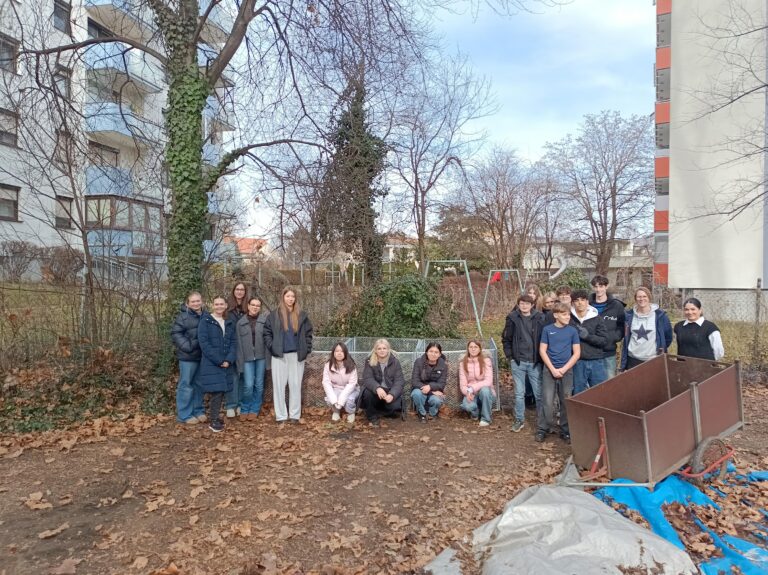
This wasn't done, but rather they learned how to handle organic waste responsibly and sustainably. During the compost project of the 1HLWb class at Schrödinger, apple cores, potato peels, shrub cuttings, mites, and worms were the big attraction. In keeping with the motto “from comp to table,” the students learned how food waste can be continuously converted into compost and then into high-quality humus, which can be used as a substrate for our school’s raised herb beds.
Also on board was the “Forum urbanes Gärtnern" from Graz, which planned the project together with two professors who will continue to supervise it in the long term in science and kitchen management classes.
Starting with the teaching of theoretical knowledge about the biological functioning, structure, layering, and maintenance of compost, the students also deepened their knowledge of soil culture and soil organisms.
Equipped with this know-how, it was time to get hands-on – pens and paper were swapped for gardening gloves and pitchforks so that a galvanized 3-chamber system could be set up in the school garden. Under the guidance of Andreas and Brigitte from the FUG, green waste was chopped up, set up chamber by chamber, and layered with compost, tree branches, and food waste.
The 1HLWb are now true composting experts who know that coffee grounds can be used for more than just reading coffee grounds!
The idea was born during a lesson in which waste management was discussed. The initiative was launched based on the response of the students, who showed interest and amazement at the topic.
- Teachers
- Other
Ideally, the compost project will follow the class throughout their five years at school. Other classes and our internal School4Future team will also be informed about the project and invited to participate.
Another goal is to fill the existing raised herb beds with compost produced by the students themselves.
The School
- Upper secondary education
If you do not see the stars or if “Select a rating” is not working, please adjust your privacy settings. Scroll to the bottom of the page, click on “Change my settings”, and select “Accept all”.
5 Reviews on “Cooking & Composting”
Tolles Projekt! 🙂
Now that’s truly thinking and acting in cycles! Wonderful!
Super!
Spannende Idee!
Kommentar