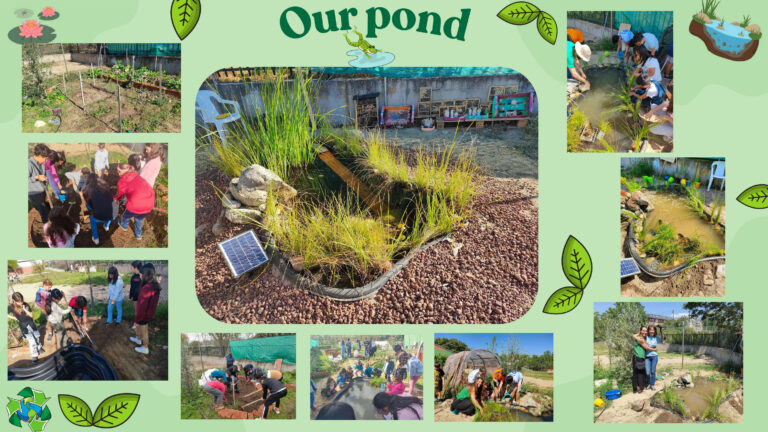
• Task 1: Design and construction of a small pond in the school garden to create a
freshwater habitat.
•Task 2: Workshop on “Ecological Importance of Ponds and Amphibians & Issues with Invasive Species” aimed at raising awareness of aquatic habitat conservation, conducted by GREFA.
Justification:
• Science: Study of freshwater ecosystems, water quality, and biodiversity through
seasonal monitoring.
• Technology: Use of simple measuring tools and school water-testing kits.
• Engineering: Planning and maintenance of the pond structure and water system.
• Art: Design of illustrated field notebooks and visual observation records.
• Mathematics: Data recording, comparison of seasonal results, and basic data
interpretation.
Impact on SDGs:
• Promotes biodiversity and habitat creation (SDG 15).
• Supports climate action and local ecosystem resilience (SDG 13).
• Enhances environmental education through long-term observation (SDG 4).
The school wanted to create a real aquatic ecosystem to support biodiversity and handson
science learning. The pond was designed to help students understand freshwater
habitats and climate-related water issues. It also supports outdoor and experiential
learning.
• Task 1: Creation of a seasonal field notebook to monitor the pond, including physical,
chemical, and biological parameters (water temperature, transparency/turbidity, water
level, pH, nitrates, phosphates, aquatic animals, aquatic plants, and algae abundance).
STEAM and SDG
Task2 :Creation of Informative Panels for the School Garden
Development of two educational panels in the STEAM classroom:
1. “Who’s Who? Pollinating Insects”
2. “Ponds and Their Amphibians”
STEAM and SDG Justification:
Science: Identification of species and their ecosystem roles.
Technology: Use of digital illustrations and printing of educational panels.
Engineering: Design of weather-resistant informational materials.
Art: Creation of visually impactful educational panels.
Mathematics: Organization of information and proportion of species in the
ecosystem.
Impact on SDGs:
Raises awareness about biodiversity importance (SDG 15).
Involves the school community in environmental conservation (SDG 13).
Steam project
The pond now hosts aquatic plants and attracts insects and other small animals. Students
regularly collect data on water quality and living organisms. The field notebook has
helped structure seasonal scientific observations.
The pond has increased biodiversity in the school garden. It has become a key learning
space for environmental science and sustainability. Students now better understand
ecosystem balance and water quality.
Students helped design, build, and maintain the pond. They measure physical, chemical,
and biological parameters and record data in field notebooks. They also observe and
identify aquatic species.
- Students
- Teachers
- Green Team
- Facility manager
The school plans to expand monitoring to include long-term biodiversity trends. Students
will compare seasonal data and create simple reports. They will regularly record key
physical parameters (water temperature, water level and transparency), chemical parameters (pH and
nutrients), and biological parameters (presence of aquatic animals and algae abundance).
This simplified system will allow students to analyze cause-and-effect relationships
between nutrients, algae growth, water clarity, and living organisms. The data will be
compared across seasons to identify environmental changes and trends.The pond will be
used for cross-curricular projects.
- Early childhood education
- Primary education
128 Reseña en “POND PALS!”
desde pequeños creando conciencia
¡Genial!
❤️
Enhorabuena!! Un gran proyecto
❤️
💫
Good Job
Enhorabuena a todos los alumnos!
Un proyecto muy creativo realizado por los alumnos del colegio.
Genial
Un proyecto muy trabajado por todo el colegio ¡¡enhorabuena!!
gran iniciativa felicidades
Maravilloso
Enhorabuena por esta iniciativa para aumentar y conservar la biodiversidad.
Proyecto fabuloso
Great initiative!!! love it!
Fantástico
Gran proyecto , gracias
Marcelo usa!!!
great!
woooooww!!!!! me encanta!!!
incredible!!w👍
Muy chulo
I Love the idea. Congratulations!
perfecto
👏👏🫶 excelente
Me encanta!
Amazing!
Buen trabajo
Fantastic!
Gran trabajo!! Una idea muy buena para el huerto
OMG!
proyecto excelente…
Fantástico
Muy necesario!
Such an inspiration! 👏🏻👏🏻👏🏻
que interesante!
Interesante iniciativa!
Marvellous
Very interesting!
👌👌👌
👌👌👌
Enhorabuena por el gran trabajo!
Me encanta
maravilloso
Great idea!
🍀 Great initiative!
woww
Bravo!
¡Enhorabuena por este excelente proyecto! ¡Que gran idea!
Estupendo. Adelante con la biodiversidad.
Super interesante. Ojalá más personas se impliquen
Un programa muy completo.
👏👏👏
Me parece un proyecto muy interesante. La mejor forma de aprender es de forma activa y vivencial.
Me encanta el proyecto!
Genial
una gran iniciativa
👍 Gran proyecto
muy buena iniciativa para concienciar a nuestros peques, en la importancia del ecosistema.
original!
Estupendo proyecto para el huerto del colegio.
precioso proyecto ampliable además a granja de anfibios en un futuro con renacuajos y ranitas
The pond will bring life and biodiversity to the school. Great initiative!
Hábitat needed for endangered species. Grate idea!🦎
😍😍😍
me encanta!!
😍
Precioso proyecto
¡Qué proyecto tan chulo!
Genial!!!!
🤔muy interesante.😄Y es genial.
🤗😍😍😍
Es una fantástica idea
Excelente. Buena idea.
🤗🤗🤗
Muy buena iniciativa! Qué importante es cuidar nuestro entorno y que desde pequeños se conciencien!
¡Muy buen proyecto! Enhorabuena.
👏🏻
👏🏼👏🏼
goog job
Great project. Congrats!
interesting
Excellent job!
Iniciativa muy chula!
Genial
😃😃
Mola!
Good job.
Oso interesgarria!
¡Un gran proyecto!
Impresionante!!
Great!! Big idea!!
Maravilla 😊
Es un proyecto precioso para favorecer el aprendizaje práctico, la observación y la conciencia medioambiental de los peques.
¡Super excelent and beautifull!
Excellent project!
It is very important to raise awareness of the importance of wetlands, and this project is perfect for that! Even small ponds in gardens are very important for wildlife! I really like it! Congratulations! 🙂
Pretty nice!
Its goood! 👍
Very good
Tolles Projekt!
That is great!
¡Una gran iniciativa para acercar la ciencia y el respeto por el medio ambiente a los alumnos!
Un proyecto genial!
¡Genial idea! 🌵
Maravillosa iniciativa
Precioso proyecto!! Ojalá lo hicieran en más colegios.
Congratulations! That’s a great idea.
Great idea!
Proyecto muy necesario de renaturalización del entorno con especies autóctonas.
Iniciativa muy interesante. La implicación en la biodiversidad ayuda a entenderla mejor y a cuidarla
Bonito proyecto par concienciar a los alumnos lo importante que es cuidar el ecosistema
Excelente
Fantástica iniciativa para entender y cuidar los ecosistemas
It is a fantastic project that enriches biodiversity and offers students hands-on learning opportunities about ecosystems and environmental stewardship. I love the idea.
This is an inspiring, well-structured project with a tangible impact on both the local ecosystem and the students’ environmental awareness. It is a fantastic example of hands-on learning.
Gran proyecto para el cuidado de la naturaleza.
Excelente idea para iniciar a los niños en pequeños proyectos de ingeniería, y de crear conciencia sobre la importancia de los ecosistemas.
Fantástica iniciativa para contribuir al ecosistema donde se emplaza el huerto escolar.
Muy interesante el proyecto en general.
Nice idea & the pond looks great 🙂
genial proyecto
GENIAL Proyecto para incluir en el huerto!
I love this idea! It looks incredible!
Estupendo para cuidar y proteger la biodiversidad además de enfrentarse a retos que hay que resolver: cómo mantener el agua limpia, qué plantas poner, estudiar la capacidad, rampa de anfibios…da para trabajar muchas cosas con el alumnado.
Gran iniciativa para tener muchos bichitos y poder observarlos
gran proyecto de concienciación del cuidado de la Naturaleza y del entorno.