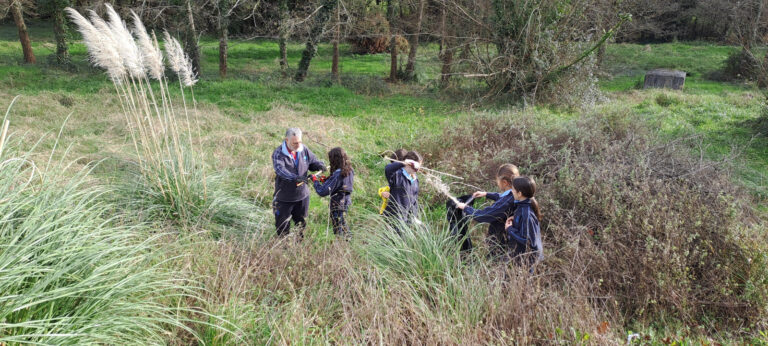
This green initiative is developed as a Learning Situation within the subjects of Science and Physical Education with 150 fifth-grade students.
The project starts from a problem-based learning scenario:
A group of friends go out to look for snails but cannot find any. This situation encourages students to reflect on biodiversity loss and ecosystem imbalance by asking questions such as what snails eat, why their food may be missing, and what environmental factors could be causing their disappearance.
From this starting point, students formulate hypotheses and identify the lack of native plants as a possible cause, leading to the study of invasive plant species.
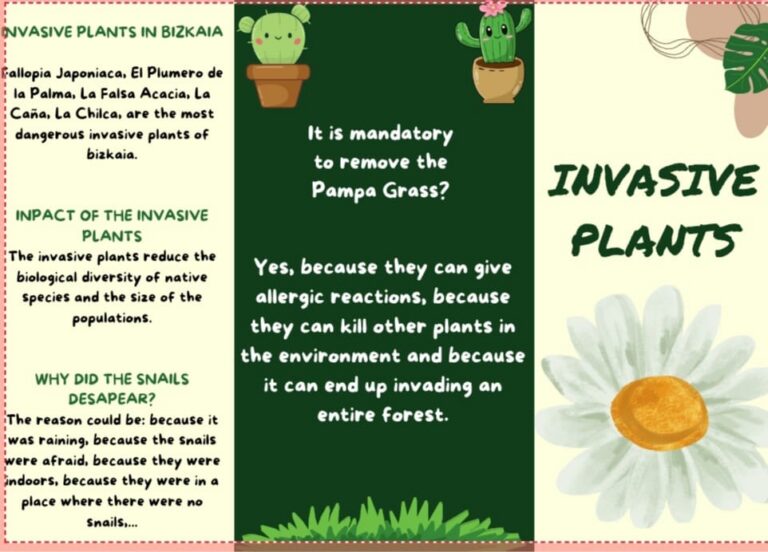
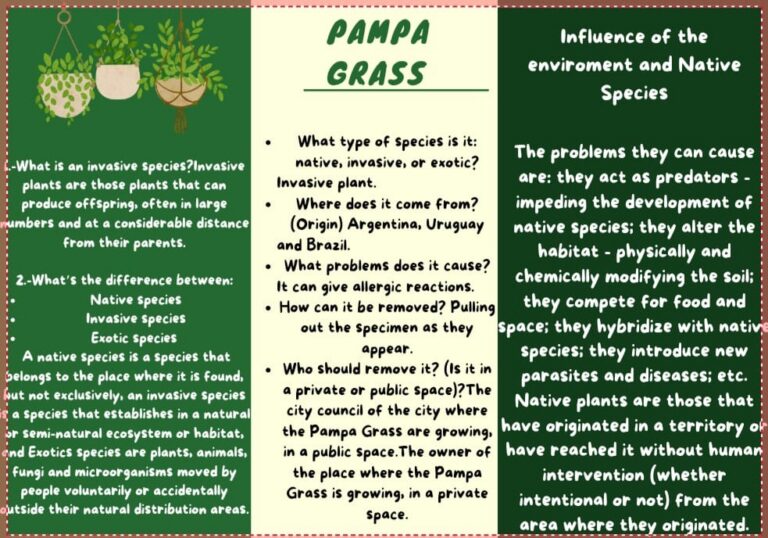
Students then carry out guided research in order to collect information that they later organise and present in an informative triptych created in Canva. Their research focuses on:
– What an invasive species is
– Differences between native, invasive and exotic species
– Invasive plants in Bizkaia
– Influence of invasive plants on the environment
– Impact on biodiversity and local fauna
– Pampas Grass (Cortaderia selloana):
* Type of species (invasive)
* Origin
* Problems it causes
* How it can be removed
* Who is responsible for its removal in public and private spaces
The triptych includes texts, images and audiovisual material and explains students’ hypotheses and conclusions about why snails have disappeared.
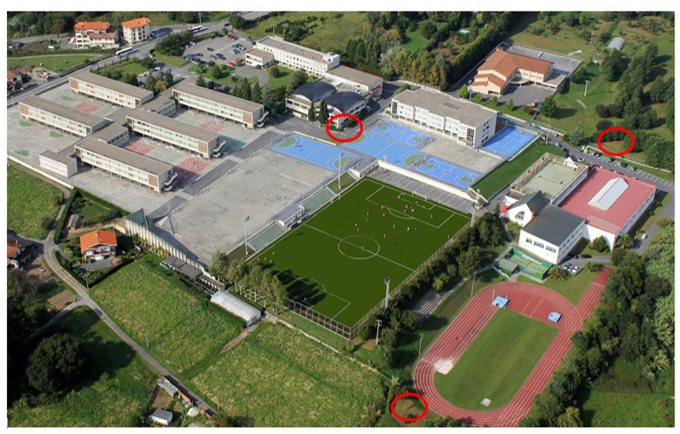
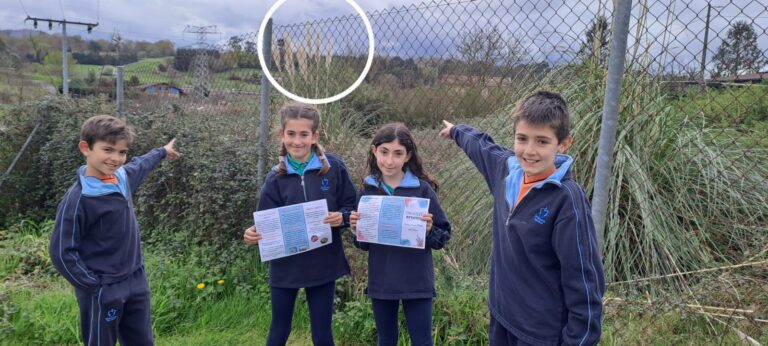
The learning situation is completed with an exploration of the local environment to identify areas affected by Pampas Grass and a supervised field trip in which students participate in cutting and removing this invasive plant, connecting learning with real environmental action.
– Connect curriculum learning with real environmental problems
– Raise awareness about invasive species
– Encourage environmental responsibility and active citizenship
– Prevent the spread of Pampas Grass in the local area
– Viewing an educational video about invasive plants
– Answering guided research questions
– Investigating invasive species and Pampas Grass
– Creating an informative Canva triptych (triptych format)
– Identifying Pampas Grass in the surrounding environment
– Supervised field trip to cut and remove Pampas Grass
– Reflection and conclusion activities
– School exhibition and family presentations
The project was carried out using school resources and free digital tools such as Canva. No external funding was required.
– Increased awareness of invasive species and biodiversity loss
– Students acquired scientific and environmental knowledge
– Creation and dissemination of informative materials
– Active participation in prevention and removal actions
– Sharing information within the educational community
– 150 pupils involved
– Interdisciplinary work (Science and Physical Education)
– Real environmental action in the local environment
– Increased awareness among students, families and staff
Students’ ideas, interests, and prior knowledge were collected through an initial questionnaire, which guided the learning situation. Their hypotheses, research, decisions, and conclusions were actively taken into account throughout the project. Additionally, a final questionnaire was administered to assess what students had learned, as well as to evaluate other aspects such as their level of engagement, critical thinking, collaboration, and overall perception of the project.
- Students
- Teachers
- Otros
– Ensure that the school grounds remain free of Pampas Grass through regular monitoring and maintenance
– Promote a municipal campaign to remove Pampas Grass and prevent its spread in the local community
– Communicate with the local municipality to coordinate action in public spaces
– Extend the project to other year groups to increase awareness and participation
– Continue raising awareness through school exhibitions, social media, and educational activities
- Early childhood education
- Primary education
- Lower secondary education
- Upper secondary education
80 Reseña en “Invasive Species Learning Situation: Pampas Grass (Cortaderia selloana)”
Amazing.
Very interesting. Well done!
Good job.
Great initiative. Good job
Excellent job!
A very necessary initiative that combines education and environmental action against invasive species, fostering ecological awareness and a commitment to biodiversity
Superb
Great job, well done!
Well done!
Great Job!!!
Great!
good
well done!!
Good job
Good job!
Great Job
Really good job guys!
Brilliant!
Perfect 💚
Excellent!!!
Amazing Goal!
Good work!!👍
Buen trabajo!!!
Good job!
It’s great that we are aware of the real damage our local environment is suffering. Good job!
Great project!
Top! Great job
Great job!
❤️❤️❤️
Very interesting!!!!
Very risky for local and key other types of plants, good topic
Great Job!
Fantastic job!
Really nice initiative about an unknown problem
Buen trabajo
Good job, congratulations!!
GREAT!!
Good
very interesting
Precioso!
Well done
Great Job !!!
Congratulations!
💛
👏🏻👏🏻👏🏻
Great iniciative
A project that motivates our chiilren and show them how easy is to damage Nature Ecosystems and how difficult it’s to recuparate them.
Excellent job!!!
Excellent project!
🫶🏽
great job
Good! Congratulations on an interesting work!
Very interesting project focused on a real local problem!!!
Great job about a great real problem. Good structure with hypotheses, research, decisions, and conclusions. Congratulations!!!!
Nice Job!
nice approach: from the students observation – to scientific research – to action!
Really interesting!!
great project and initiative! well done guys!!!
Excellent job!
Fabulous teacher-students collaboration!
👏🏽
Amazing
Súper interesante! 💚
Very interesting project 👍🏻
Well done!!!
Excellent proposal!
One of the biggest problems in the nature is the loss of biodiversity. Learning about this could help them become more conscious of this issue.
Good job!
Great!. Excellent!
¡Maravillosa iniciativa!
Great initiative ⭐⭐⭐⭐⭐
Really nice work!!! Well done
Excellent
Excellent !!
Love it
Muy bonito
Great proposal
Great!!
❤️❤️
Great initiative
👍